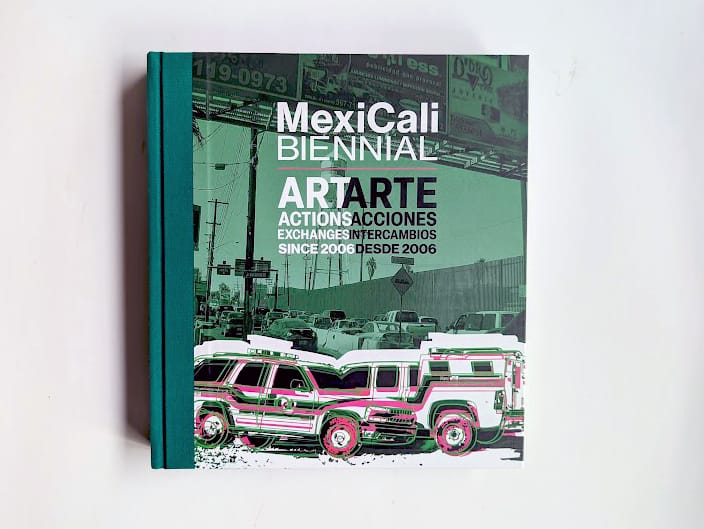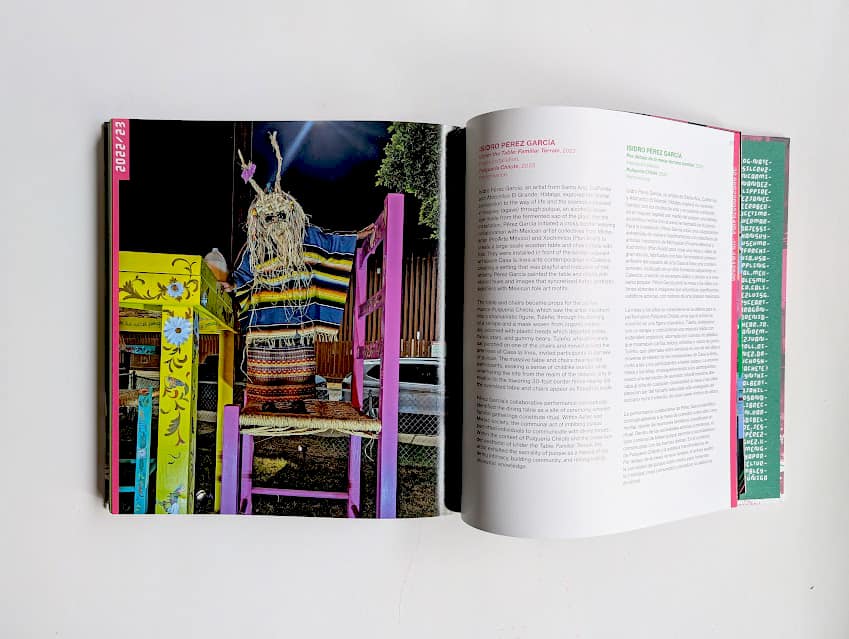
Please check out the Mexicali Biennial’s recently released catalog MexiCali Biennial: Art, Actions, Exchanges since 2006. I was very honored to have my work featured in the catalog as part of Amy Sara Carroll’s essay,”RE/DE/LI/NE/A/CIÓN: Cross-Border Text-Image Environments and the Mexicali Biennial.”
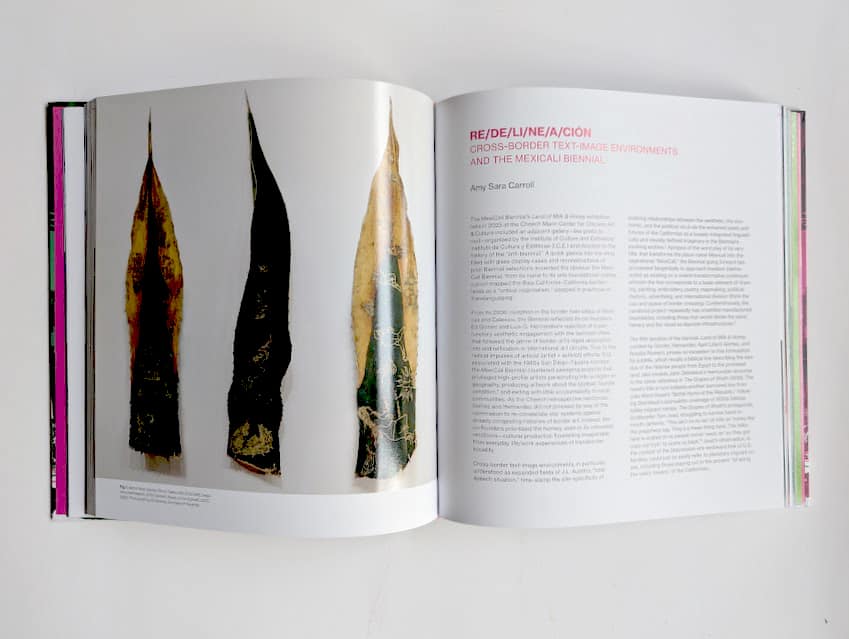
Here is just a short excerpt:
Pérez García’s grouping of three pencas can be read left to right or vice-versa. Freestyling pre- and postcolonial iconography beyond word/image binaries, Pérez García recalls with Penca Tlaltecuhtli the Aztec deity of sacrifice. Neither male nor female, Tlatecuhtli refutes “gender as a colonial idea.” Neither living nor dead, the figure anticipates the maguey’s passage through timespace. Glyphs of a heart and the knife ritually used to remove it from a body, establish other through lines of the graphic narrative, forcing the reader to scan the text from top to bottom (or vice-versa). Seguimos chambeando hangs vertically, but is also legible horizontally. Its title curves into labial folds as if invagination, refusing lubrication, ages into its sweetest and fullest articulation, moving North to South in the lifespan of the fifth iteration of the biennial. A sly reference to an action by the artist’s brother on the banks of the Santa Ana river grounds the penca in the nest of a human, wearing a crow’s mask. Crowning the otherwise androgynous figure, a paleterx/a/o/e trumpets their wares per the artist’s memories of a musician-vendor in his neighborhood and his own bittersweet teenage experiences of vending and consuming paletas. Pérez García poses a deceptively simple question: How does work, the very idea of labor (hear the echoes of birthing here, too), shift crossing the Mexico-US borderline?
The catalog as a whole chronicles the Mexicali Biennial’s nearly two decades of binational, interdisciplinary programming along the California–Mexico border. Find the catalog on their website, available for purchase.